

Sustainability
Impact Report 2024
Sustainability
Impact Report 2024
Sustainability
Impact Report 2024
Meat & Livestock Australia (MLA) – as a service provider to the Australian red meat and livestock industry – is committed to providing our stakeholders with the science, technology and adoption practices they need to meet changing market expectations and conditions.

Michael Crowley
Managing Director
This report highlights MLA’s sustainability-focused programs and projects that have demonstrated significant outcomes over the past 12 months. It includes outcomes that will deliver enduring positive impacts to our stakeholders through practice change and the ability to unlock new supply chain pathways and opportunities.
MLA takes its strategic direction from Red Meat 2030, our industry’s 10-year strategic plan, which outlines the red meat industry’s key objectives to:
- double the value of Australian red meat sales
- be the trusted source of the highest quality protein
- achieve carbon neutrality by 2030.
MLA’s Strategic Plan 2025 charts our strategic direction and the investment priorities that will contribute to the sustainability, profitability and global competitiveness of the Australian red meat and livestock industry.
For sustainability investments to be impactful and valued by the supply chain, they must improve our stakeholders’ financial performance, the stewardship of their land, livestock and natural resource base, and their resilience to climate change impacts and extreme weather events.
Our sustainability investments must be scientifically proven and evidence-based, and our practice pathways must be focused on building capacity and capability of our people to meet evolving market challenges and opportunities.
As custodians to over half the nation’s land mass, livestock producers are more exposed than most to the vagaries of drought, extreme weather and climate change. Our industry and its viability are directly tied to our dependency on our livestock and our land. The protection of our livestock and our environment will in turn support the priorities of our customers, consumers and community, and strengthen our trade access and attractiveness to markets.
This report cannot do justice to the breadth and depth of sustainability investments across MLA’s programs, priorities and projects. Rather, it seeks to highlight those initiatives that have achieved significant impact regarding sustainability over the past 12 months.
Sustainability highlights 2023–24
The hub is a one-stop shop for best practice information on the safe, humane transportation of cattle, sheep and goats
Find out moreThe resources offer guidance on portion sizes, nutritious choices containing Australian red meat and ‘no food waste’ tips
Find out moreMLA’s market access program is focused on removing non-tariff barriers to trade, with an estimated $470 million having been eliminated since 2020
Find out moreCarbon EDGE is MLA’s new two-day training program, providing participants with an understanding of emissions reduction and carbon storage activities relevant to a livestock grazing business
Find out more- Environmental credentials platform launched at Beef Australia 2024
- Digital carbon calculator includes new capabilities
- Quick start carbon calculator released as part of MLA’s free e-learning resources
Bovaer®10 (3-NOP by DSM) has demonstrated dual methane reduction and productivity improvement benefits
Find out moreThe Federal Government has provided ISC with a grant to redevelop the National Livestock Identification System. The uplift will:
- provide a fit-for-purpose and user-friendly traceability platform
- deliver flexibility and scalability to track all livestock movements
- ensure our integrity systems are better placed to meet the future needs of their many users.
Several projects across MLA’s product and packaging innovation program have identified opportunities for the Australian red meat industry to create additional revenue streams
Find out moreResearch is underway to develop Estimated Breeding Values (EBVs) and Australian Sheep Breeding Values (ASBVs) for methane and feed efficiency traits for cattle and sheep
Find out moreOverview
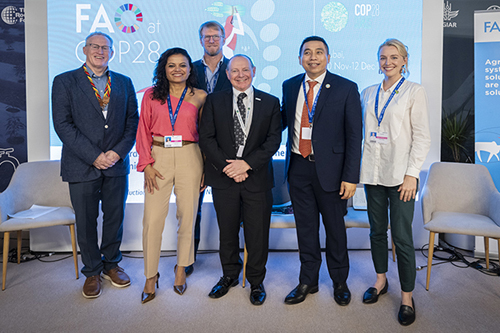
International policy context
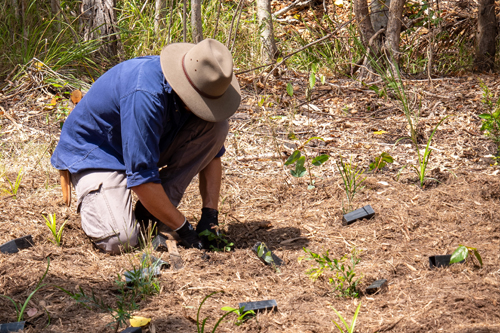
Australian policy context
The Albanese Government has continued to put sustainability at the front and centre of policy making in Australia.
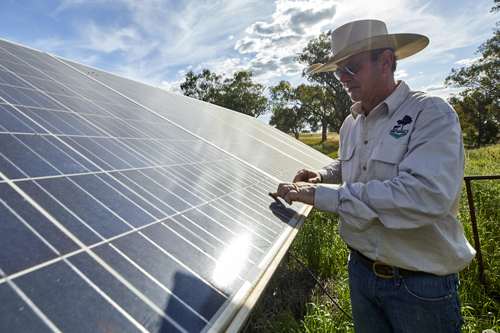
Disclosures and reporting
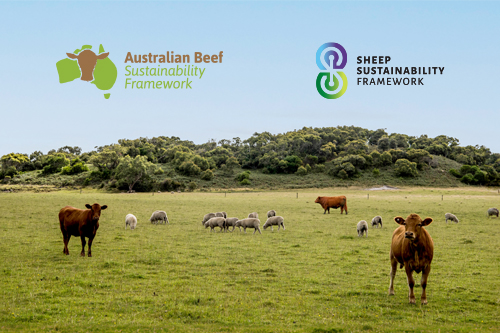
Our sustainability frameworks


Collaborative partnerships
MLA has a long history of collaborating with the Australian Government, research organisations, value chain partners, cooperative research centres, and other research and development corporations by co-investing in projects and consortiums. Our current partnerships in the sustainability space include:
Net Zero Emissions Agriculture CRC
The new Net Zero Emissions Agriculture CRC has secured an unprecedented $300 million research fund to drive Australian agriculture’s transition to net zero emissions by 2040. This represents the largest CRC by funding dollars in the country.
MLA is a co-contributing partner, joined by:
- 5 state and territory governments
- 10 universities, major agriculture, agrifood and ag-tech enterprises
- farm retail businesses
- producer groups with thousands of members.
Livestock emissions is one of four priority investment streams. The CRC will leverage additional research and extension funding from the $300 million total funding over the next 10 years.
Farming for the Future
The Farming for the Future program has spearheaded the largest dataset of its kind globally, identifying relationships between natural capital and financial/production data across 130 farms nationally.
Robust datasets are seen as critical to building the large-scale evidence base of natural capital and farm business relationships. MLA has partnered with the Macdoch Foundation on the project to ensure close alignment with industry priorities and challenges.
Farming for the Future provides producers with the evidence to substantiate a business case of when to invest in natural capital to build productivity and climate resilience and harness market opportunities.
The program has three main workstreams:
- Building a large-scale evidence base for the relationship between natural capital and farm business performance and profitability
- Building capability and a diagnostic tool, moving beyond research to enable farm decision making on natural capital investments
- Working with businesses beyond the farm gate to align the system and incentivise investments in on-farm natural capital, including working with the Australian Sustainable Finance Initiative to improve capability and collaboration with the banking sector.
The program found direct relationships between natural capital and business performance, termed the double dividend pay-off zone and trade-off zone. Natural capital assets were identified across the four constructs of native ecosystems, planted vegetation, intensive land-use systems and water resources with natural capital indices defined as soil condition, ecosystem integrity, aggregation, connectivity and proximity, forage condition and aquatic condition. The project further scoped the opportunities available to farm businesses to deliver ecosystem services such as shade, shelter, pollination, pest control and forage provision.
Farming for the Future delivered strong evidence of significant resilience benefits to different types of shocks including rainfall variability, input and output variability and terms of trade, highlighting the need for minimum natural capital investments to confer farm resilience.
All participating farms have been provided with farm-scale natural capital accounts, giving them remote-sensed and field-validated assessments of their farms. Some participants have begun actioning their accounts to prioritise on-farm natural capital investments and negotiate better financial lending outcomes.
The program has begun the development of a farm-scale natural capital benchmarking prototype to enable assessment of natural capital assessments between peers and accelerate peer-to-peer learning and adoption outcomes.
Farming for the Future plans to scale up in farm type and sample size to improve its statistical power from the current 130 farms based in NSW, Victoria, Tasmania and WA to 300 farms expanding to SA and Queensland.
Australian Agricultural Sustainability Framework
The Australian Agricultural Sustainability Framework (AASF) is set to release its first prototype report by the end of 2024, providing the first report card of insights and data for demonstrate Australian agriculture’s sustainability commitments and claims.
The ABSF and SSF have been working with the National Farmers Federation (NFF) since AASF’s inception in 2021 to ensure alignment of priorities, indicators and metrics across Australia’s agricultural sectors.
The AASF has been developed in partnership with the Australian Government to develop the framework to enable Australian agriculture to demonstrate its sustainability credentials to markets and community.
The AASF is based on 17 principles across three aspects of Environmental Stewardship, Social Responsibility and Good Governance, with each principle supported by criteria to aid in reporting against the framework.
NFF is working with AASF delivery partners including the Australian Farm Institute and CSIRO to implement key priorities and activities including:
- AASF’s first materiality assessment against international and domestic priorities due for completion by the end of this financial year
- Designing a data ecosystem to increase ease of access, interoperability and efficiency in use of sustainability data
- Establishment and evolution of the AASF Community of Practice of collective partners including continuing to evolve the AASF model, its governance, responsibilities and administration
- Piloting the AASF with industry, supply chain and finance end-users
- Hosting a sustainability traceability working group.
AASF is aligned with global initiatives including the United Nations Sustainable Development Goals, the Sustainable Agriculture Initiative, Sustainability Assessment of Food and Agriculture Systems, the Taskforce for Climate-related and Nature-related Financial Disclosures and with Australian commodity initiatives.
Community Trust in Rural Industries
MLA is a partner in the Community Trust in Rural Industries (CTRI) program, a multi-industry research collaboration, to understand, track and build community trust and acceptance of Australia’s rural industries.
A survey conducted in 2023 revealed:
- 91.4% of survey respondents from the Australian community agreed that rural industries are important to our way of life in Australia, marking a notable increase from 88.2% in 2022
- 87.8% of respondents agreed that regional communities are important for producing safe, high quality food and fibre products
- 85% of respondents agreed that rural industries generate significant jobs in regional areas
- 61.7% of respondents said they feel connected to farmers, fishers and foresters when they buy Australian rural industry products.
Research found the management of the environment to be the strongest driver of trust in 2023, closely followed by animal welfare, which continues to be a complex but vitally important topic. The research also found a continued need for rural industries to demonstrate their responsiveness to community concerns and notably that the heritage and rural identity of Australians has emerged as an important driver of trust to watch.
Collectively, CTRI canvassed over 22,000 Australians since the beginning of the program in 2019. The CTRI program is a collaborative effort between MLA, AgriFutures Australia and seven other RDCs.